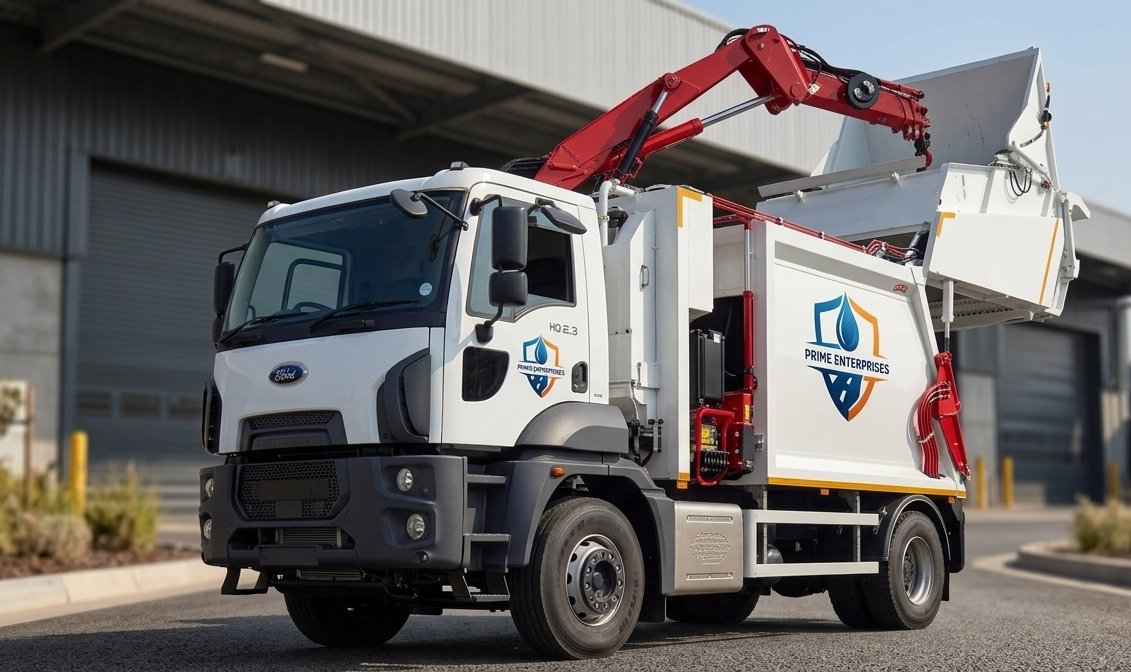
"Garbage compactor" covers a wider range of equipment than most first-time buyers expect, and the wrong choice usually shows up within a few months — as routes that take longer than planned, collection points that overflow between visits, or a truck that's the wrong size for the streets it has to reach. The right equipment choice comes down to one question: how is waste actually generated and staged in the area you're collecting from?
Crane compactors & hook-lift systems — for containerised and bulky waste
Crane compactors and hook-lift (skip-loader) vehicles pick up and empty removable containers rather than collecting loose waste directly. They suit locations that generate waste in bulk or in spurts — construction sites, factories, market yards, and transfer stations — where a fixed container can fill up between visits and a single chassis can service different container types across a route. If your waste sources are industrial or commercial rather than household doorsteps, this is usually the starting point.
Auto tippers — for smaller towns and single-operator routes
An auto tipper uses a hydraulic lifting arm to pick up and empty standard waste bins directly, without a separate loader or second crew member. That makes it well suited to smaller municipalities, residential layouts, parks, and rural panchayats where route density is lower and a single operator handling the whole collection run keeps costs down.
Compactor trucks — the municipal workhorse
The standard rear- or side-loading compactor truck is still the most common vehicle for day-to-day household waste collection. Its hydraulic compaction system compresses loose waste as it's loaded, letting one vehicle carry significantly more refuse per trip than an uncompacted load would allow — which directly reduces the number of round trips to the disposal or processing site, and the fuel and crew-hours that go with each one.
Underground bin systems — for dense urban cores
Underground collection systems keep most of the storage volume below street level, with only a compact access point above ground. They're a good fit for dense city centres, heritage areas, and high-footfall zones where a full-size bin bank isn't practical, visible waste storage is undesirable, and space at street level is at a premium.
Matching equipment to ward-level volumes
In practice, most municipalities end up running more than one of these types across different zones rather than standardising on a single vehicle citywide — commercial and industrial pockets on crane compactors or hook-lifts, dense residential wards on compactor trucks, outlying or low-density areas on auto tippers, and select high-density or heritage zones on underground systems. Mapping your actual waste-generation pattern, ward by ward, before finalising a purchase is what usually saves a procurement cycle from having to be repeated within a year or two.
Not sure which collection system fits your ward mix? See our garbage collection systems or talk to our team — we can help you match equipment to your actual routes and volumes.